Category: Alexandria

The Bibliotheca Alexandrina, located in Alexandria, Egypt, is a modern marvel built to honor the legacy of the ancient Library of Alexandria, once the world’s most famous center of learning. Officially inaugurated in 2002, this impressive library serves as a hub for knowledge, culture, and innovation, attracting scholars, students, and tourists from around the world.

Historical Background

The original Library of Alexandria, established around the 3rd century BC, was one of the largest and most significant libraries of the ancient world. It housed hundreds of thousands of manuscripts and scrolls, representing the pinnacle of knowledge in literature, science, and philosophy. The modern Bibliotheca Alexandrina was built to revive this intellectual tradition, combining cutting-edge architecture with a mission to foster global education and cultural exchange.

Architectural Features

The Bibliotheca Alexandrina is renowned for its unique and futuristic design, created by Norwegian architectural firm Snøhetta. Key features include:

  • A massive tilted circular roof, symbolizing the rising sun and the light of knowledge

  • Walls engraved with characters from over 120 languages

  • Extensive reading rooms, conference centers, and specialized libraries

  • Museums, art galleries, and a planetarium to support cultural and educational programs

The combination of modern design with cultural symbolism makes the library not only a functional knowledge center but also a tourist attraction and architectural landmark.

Cultural and Educational Significance

The library hosts millions of books, manuscripts, and digital archives, making it a major educational resource in Egypt and the Middle East. It offers:

  • Specialized research centers

  • Public lectures, workshops, and exhibitions

  • International collaborations for scholars and students

Beyond its role as a library, the Bibliotheca Alexandrina functions as a museum, art gallery, and conference center, making it a multifaceted cultural destination.

Visiting Tips

  • Allocate at least 2–3 hours to explore the library and museums fully.

  • Take a guided tour to learn about the library’s architecture and history.

  • Visit the planetarium for interactive astronomy presentations.

  • Don’t miss the museums of manuscripts and rare books for a deep dive into global knowledge.

Conclusion

The Bibliotheca Alexandrina Egypt is a symbol of knowledge, culture, and innovation, bridging the past and present. Visiting this modern library allows travelers and scholars alike to connect with the intellectual legacy of ancient Alexandria while experiencing a state-of-the-art cultural hub.

The Roman Amphitheater in Alexandria is a prominent historical site reflecting the city’s rich Roman heritage. Built during the Roman period, this amphitheater served as a cultural and social hub for theatrical performances, musical shows, and public gatherings. It is a rare example of Roman architecture in Egypt and offers visitors a glimpse into Alexandria’s vibrant past.

Alexandria port front (7)

Historical Background

Constructed in the 2nd century AD, the amphitheater was designed to host entertainment for both the local population and Roman officials. It highlights the Romans’ appreciation for art, performance, and public spectacles. Archaeologists have studied the site extensively, uncovering remnants of seating arrangements, stage structures, and decorative elements that reveal the sophistication of Roman engineering.

The amphitheater was part of a larger Roman complex in Alexandria, which included temples, baths, and public spaces, emphasizing the city’s importance as a major center of Roman culture and administration.

Architectural Features

The Roman Amphitheater in Alexandria is noted for its:

  • Semi-circular design, typical of Roman theaters

  • Tiered seating capable of accommodating hundreds of spectators

  • Stone construction with remnants of decorated columns and arches

  • Strategic location near major Roman complexes for easy access

The design ensured optimal acoustics, allowing audiences to hear performances clearly, and demonstrates the advanced engineering techniques employed by Roman architects.

Cultural and Tourism Significance

Today, the amphitheater is a must-visit landmark in Alexandria, attracting historians, archaeologists, and tourists alike. It provides insights into the cultural life of Roman Egypt, illustrating how public entertainment was intertwined with civic and religious practices.

Visitors can explore the seating areas, stage, and nearby ruins, gaining a comprehensive understanding of the historical significance of this ancient site. Photography enthusiasts also find the amphitheater’s structure and surrounding ruins ideal for capturing Alexandria’s ancient beauty.

Visiting Tips

  • Visit during early morning or late afternoon to avoid crowds and enjoy optimal lighting for photos.

  • Wear comfortable shoes as some areas have uneven surfaces.

  • Pair your visit with nearby Roman sites, such as Pompey’s Pillar, for a full historical tour of Alexandria.

Conclusion

The Roman Amphitheater Alexandria is a striking testament to the city’s Roman past. Its architectural elegance, cultural importance, and historical value make it an essential destination for anyone exploring Alexandria. Experiencing this site allows visitors to connect with the ancient traditions, entertainment, and social life of Roman Egypt.

The Catacombs of Kom El Shoqafa, located in Alexandria, Egypt, are one of the most significant historical sites of the ancient world. Dating back to the 2nd century AD, they are considered one of the Seven Wonders of the Middle Ages and serve as a testament to Alexandria’s multicultural past. This underground necropolis showcases the artistic and architectural fusion of Egyptian, Greek, and Roman traditions, making it a must-visit landmark for history enthusiasts and travelers alike.

Historical Background

Constructed during the Roman period, the Catacombs of Kom El Shoqafa were originally built as a burial place for wealthy families. The site demonstrates Alexandria’s diverse cultural landscape, where Egyptian, Greek, and Roman influences merged seamlessly. Over time, it became a prominent burial site that reflected the city’s cosmopolitan nature and religious diversity.

The catacombs were rediscovered in the early 20th century and have since been preserved as a historical monument. Archaeologists have studied the site extensively, uncovering artifacts, statues, and wall carvings that reveal the complex funerary practices of ancient Alexandria.

Architectural Features

The Catacombs of Kom El Shoqafa are spread over three main levels connected by staircases and narrow passageways. Visitors can admire:

  • Egyptian-style tombs: adorned with traditional motifs and hieroglyphs

  • Greek influence: sculpted columns and reliefs reflecting Hellenistic art

  • Roman elements: arches, frescoes, and statues depicting mythological scenes

The central hall is particularly impressive, featuring a circular shaft with a spiral staircase leading down to the lower chambers. This combination of design elements makes the catacombs a unique architectural marvel.

Cultural and Religious Significance

The site reflects a period when different cultures and religions coexisted in Alexandria. It contains funerary statues, sarcophagi, and carvings that illustrate rituals and beliefs of the time. Scholars consider the Catacombs of Kom El Shoqafa an important resource for understanding the social and religious history of Roman Egypt.

Visiting Tips

  • Wear comfortable walking shoes as the floors and stairs can be uneven.

  • Carry a small flashlight to better see the carvings in dimly lit areas.

  • Allocate at least 1–2 hours to explore the three levels thoroughly.

  • Be mindful of the low ceilings and narrow passages in some sections.

Conclusion

The Catacombs of Kom El Shoqafa are more than just an underground tomb; they are a window into Alexandria’s rich cultural past. Whether you are a history lover, archaeologist, or casual traveler, exploring this site offers an unforgettable experience of ancient Egyptian, Greek, and Roman heritage.

Visiting the catacombs provides a deeper appreciation of Alexandria’s history and its role as a center of cultural exchange in the ancient world.

Alexandria, situated on the Mediterranean coast of Egypt, is the country’s second-largest city and a major economic hub. Half of Egypt’s industrial production comes from the delta, mainly from Alexandria. Additionally, Alexandria is home to several major commercial ports such as El Diekhila, Abu Quir, Idku and Damietta.

The city’s strategic location has played a vital role in its development, with the Mediterranean coast serving as an important gateway for trade and commerce. The region is divided into four main areas, with the northwestern coastal region extending from Sallum to Alexandria  being particularly noteworthy. Alexandria  has a rich history and is considered an ancient centre of Egyptian civilization.

In the second half of the 19th century, Alexandria emerged as a critical hub for foreign capital organizing cotton production and exportation. Ever since, it has remained a major passageway for flows of capital, commodities and people. The Nile Delta, which has its apex near Cairo and extends to the Mediterranean coastline of Alexandria to Port Said, is another significant area located in close proximity to the city. This region is what makes Alexandria a prominent agricultural land, as it stands as the most productive agricultural area in Egypt. The Nile Delta and the Mediterranean coast account for up to 30%-40% of Egypt’s total agricultural production, with Alexandria being its epicenter. Moreover, the city of Alexandria concentrates approximately 40% of Egypt’s industrial activities and houses two of its largest ports, which play a crucial role in the import and export of goods. Situated in a strategic location along the Mediterranean coast of Egypt, Alexandria is an economically significant city and major hub for trade and commerce. The city owes its prominence to its strategic location, which has allowed it to flourish as a commercial and economic center.


Kom El-Shokafa

On the west of Alexandria, as for the ancient Egyptian religion, lies its City of the dead. while the ancient Egyptians mummified their dead, the Hellenistic believed in cremation.

The area of Kom El-Shokafa   used to contain a mound of shards of terra cotta which mostly consisted of jars and objects made of clay. These objects were left by those visiting the tombs, who would bring food and wine for their consumption during the visit. However, they did not wish to carry these containers home from that place of death.

1900, by mere chance, a donkey pulling a cart fell through a hole in the ground and into one of the catacombs. The discovery was made on that date by an Alexandrian, Monsieur Es-Sayed Aly.

Kom El-Shokafa, These catacombs date back to the late first century AD. Kom El-Shokafa lies on the site where the village and fishing port of Rhakotis” the oldest part of Alexandria”

The Necropolis is of the catacomb type that was widespread during the first three centuries in Italy (Rome). This type of catacomb was usually limited to the burial of deceased Christians. It was, to the believers of this new religion, an asylum where they could be safe from the injustice of the emperors.

In the tombs below the cathedral of Saint Sebastian in Rome we can find catacombs in the form of streets stretching for many miles.

But in the Necropolis of Kom el-Shuqafa there is no trace of Christian burials. The catacombs are unique both for their plan and for its decoration which represents a melding and mixing of the cultures and traditions of the Egyptians, Greeks and Romans.

Scholars believe that the catacombs at first may had served only one wealthy family that still practiced the ancient Egyptian pagan religion. However, they were expanded into a mass burial site.

Where they dug out loculi and then closed the openings with marble and limestone. The name was written on the Stele Or “stela”.

At Kom El-Shokafa there is a mix between Roman and the Pharaonic arts, which is not only represented in the architecture of the tomb, but also its engraving and statues, perhaps it was the desire of the tomb’s owner that is clear in the religious scenes shown in the drawings.

At Kom El-Shokafa, there is a shaft about six meters in diameter to lower the bodies of the deceased down to the actual burial area.

There are ninety-nine steps that decrease in height as they approach the surface, so that at the top there is almost no step at all. This was designed for the tomb visitors so that after viewing the deceased in the lower levels, the climb back up to the surface would become easier as the visitor became tired from the climb out.

To the left (southeast) of the rotunda the tombs have a funeral banquet hall called a “Triclinium”.

a wide staircase from the Rotunda, which divides to accommodate the prompter’s box (a covered shaft to the third lower level), leads down to the second level that contains the Main Tomb.

There are two  statues cut in the rock. 1st statue represents a man standing with left leg step forward and wearing kilt, he has a curly hair and Greek features, the statue is cut in Greek style.

2nd statue represents a woman standing with left leg step forward, and she is dressed in long tight fitting transparent robe, however she has curly hair and Greek features and the statue was also cut in the Greek style.

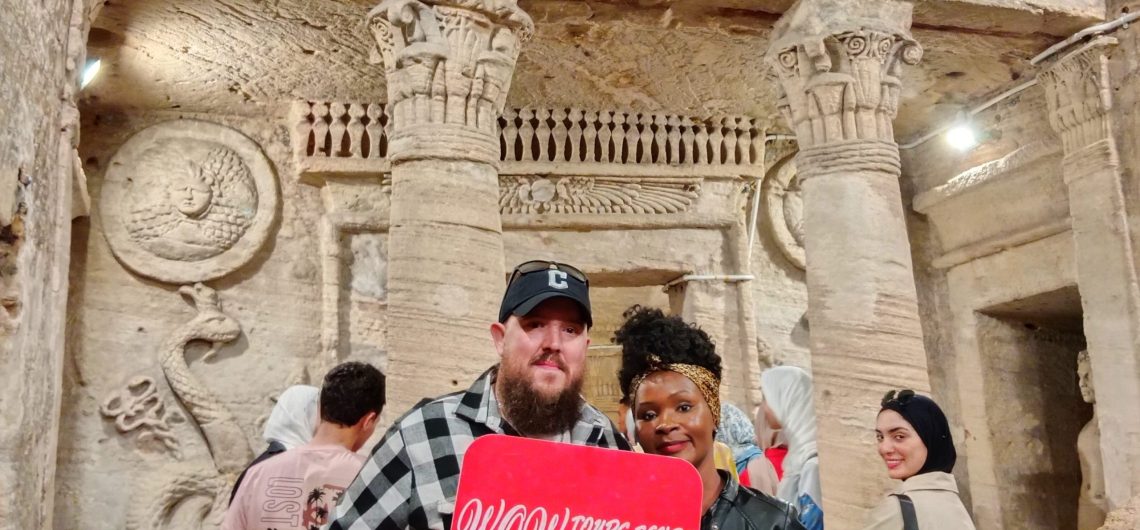
the entrance of the burial chamber, there is a round shield at the middle of which there is the face of Medouza, “Medouza is represented as the face of an ugly woman and the locks of her hair are small circles.” ,  It is believed that if someone looked at Medouza , he would turn into stone.

Beneath the shield there is a serpent holding 2 symbols one of Hermes “wisdom” and the second one for Dionysus “death”.

In one of these loculi, the mummy of a priestess of goddess “Nemesis” – goddess of revenge and sport in ancient Greek mythology – was found”, this mummy and its jewelry are now in the Graeco-Roman museum at Alexandria.

The hall of Caraculla

It is a separate tomb; however it is now approached from a break in the hall of the Rotunda. At the time of discovery, large quantities of bones were found, at the beginning scholars believed that those bones were remains of the famous massacre carried out by the Roman emperor Caraculla among the youth of Alexandria, that’s why it was called “The hall of Caraculla”.

But later on when these bones were examined, they found out that the majority of bones belong to horses. So We believe that there was a temple in this area to goddess “Nemesis” – This tomb was perhaps dedicated to burial of some horses to honor them because they had won some races.



True to Alexander the Great’s intentions when he founded the city in 332 BC, Alexandria is still Egypt’s main seaport. Two deep-water harbors serve commercial, fishing and cruise traffic. With a population of over 7 million, it is the distribution center for fisheries and cotton manufacture. More important for gourmets, the city boasts the best seafood restaurants in the country.

The broad curve of the Corniche promenade begins at the ancient eastern harbor. On the edge of the harbor promontory, the fortress of sultan Qaitbay, now housing a naval museum, stands on the site of the ancient pharos lighthouse. Built by the Ptolemies in the 3rd century BC, the beacon, 120m (393 ft.) high, rated with the Giza pyramids as one of the seven Wonders of the World until toppled by earthquakes. On the west side of the promontory is the flamboyant Ras El Tin palace, in which King Farouk signed his abdication.